How to Create a Digital Marketing Plan: A Step-by-Step Guide
Learn how to create a digital marketing plan from scratch, define goals, identify your audience, choose channels, create content, set a budget, and measure results.
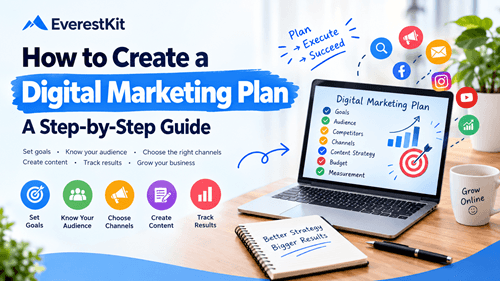
A business can have a great product or service and still struggle to get customers online. One common reason is a lack of direction.
Posting randomly on Facebook, publishing occasional blog articles, running advertisements without a clear goal, or trying every social media platform at once can consume time and money without producing consistent results.
A digital marketing plan gives your business a clear path.
Instead of asking, “What should we post today?” you can decide what you want to achieve, who you want to reach, which channels to use, what content to create, how much to spend, and how to measure the results.
In this guide, you will learn how to create a digital marketing plan from scratch, even if you are running a small business with a limited budget.
What Is a Digital Marketing Plan?
A digital marketing plan is a practical roadmap for promoting a business, product, service, or brand through online channels.
It normally covers:
- Business and marketing goals
- Target audience
- Competitor research
- Website strategy
- Search engine optimization (SEO)
- Social media marketing
- Content marketing
- Email marketing
- Paid advertising
- Marketing budget
- Performance measurement
A good plan connects all of these activities instead of treating them as separate tasks.
For example, a business might publish a blog article to attract visitors from Google, promote that article on social media, collect leads through its website, and then follow up with potential customers.
That is a strategy.
Why Does Your Business Need a Digital Marketing Plan?
Without a plan, digital marketing can become a collection of disconnected activities.
You might spend money on advertisements without knowing your customer acquisition cost. You might publish dozens of social media posts without generating inquiries. Or you might invest months in SEO without understanding which pages are actually bringing visitors.
A digital marketing plan helps you answer five important questions:
- What do we want to achieve?
- Who are we trying to reach?
- Where can we reach them?
- What should we offer them?
- How will we know whether it is working?
It also makes it easier to decide what to stop doing.
You do not need to use every available marketing channel. The best approach depends on your audience, business model, resources, and goals.
Step 1: Define Your Marketing Goals
Start with the result you want
A goal such as “get more followers” may sound useful, but it does not necessarily tell you whether the business is growing.
Instead, connect your marketing activities to a meaningful business outcome.
Examples include:
- Generate 50 qualified leads per month
- Increase website traffic
- Generate more service inquiries
- Increase online sales
- Build an email subscriber list
- Improve brand awareness
- Increase repeat customers
Your goals should be specific enough that you can measure progress.
Example
Instead of:
“I want more customers.”
Try:
“I want to generate 30 qualified website inquiries within the next 90 days.”
That gives you something measurable to work toward.
Step 2: Identify Your Target Audience
You cannot create an effective digital marketing plan without knowing who you want to reach.
Your target audience is the group of people most likely to need and purchase your product or service.
Consider factors such as:
- Age range
- Location
- Occupation
- Interests
- Problems
- Buying behavior
- Budget
- Online habits
But demographics alone are not enough.
You should also understand the problem your audience is trying to solve.
For example, instead of defining your audience simply as:
“Small business owners”
you might define them as:
“Small business owners who need more customers but do not have the time or expertise to manage SEO and social media marketing themselves.”
That description gives you much more information for creating useful content and offers.
Step 3: Understand Your Customers' Problems
Good marketing starts with understanding the customer's situation.
Ask:
- What problem are they experiencing?
- What are they searching for online?
- What questions do they frequently ask?
- What prevents them from buying?
- What alternatives are they considering?
- What information would help them make a decision?
These questions can become your content strategy.
For example, if potential customers frequently ask:
“Why isn't my website appearing on Google?”
you could create a detailed article explaining indexing, technical problems, content quality, internal linking, and Search Console.
You are not simply creating content for search engines.
You are answering a real customer question.
Step 4: Analyze Your Competitors
Competitor research can show you what is already working in your industry.
Look at businesses offering similar products or services and examine:
- Their websites
- Blog topics
- Social media content
- Services
- Offers
- Landing pages
- Customer reviews
- Frequently asked questions
- Content gaps
Do not simply copy what competitors publish.
Instead, look for opportunities to provide something more useful.
For example, if competitors have short articles about SEO, you could create a practical guide containing:
- A checklist
- Examples
- Step-by-step instructions
- Common mistakes
- Free tools
- Additional resources
Your goal should be to make the information genuinely useful to the reader.
Step 5: Audit Your Existing Online Presence
Before creating new campaigns, examine what you already have.
Check your:
- Website
- Google Search visibility
- Social media profiles
- Business listings
- Blog
- Landing pages
- Contact forms
- Email system
- Analytics
- Search Console
Look for problems such as:
- Slow pages
- Broken links
- Poor mobile experience
- Missing important information
- Weak calls to action
- Outdated content
- Difficult navigation
- Pages that receive visitors but generate no action
Google's guidance emphasizes providing a good overall page experience, including mobile usability, secure pages, Core Web Vitals, and avoiding intrusive elements that interfere with the main content.
Step 6: Choose the Right Digital Marketing Channels
You do not need to be everywhere.
Choose channels based on where your potential customers actually spend time and how they search for solutions.
SEO
Search engine optimization can help people discover your website when they search for relevant information, products, or services.
SEO is particularly useful for businesses that want to build long-term organic traffic.
Examples:
- Educational blog articles
- Service pages
- Product pages
- Helpful guides
- Comparison content
- FAQ content
Social Media
Social platforms can help businesses build awareness, communicate with customers, distribute content, and generate leads.
Depending on your audience, you might use:
- YouTube
- TikTok
You do not necessarily need all of them.
Start with the platforms that make sense for your audience and business.
Email Marketing
Email can help you maintain relationships with people who have already shown interest in your business.
You can use it for:
- Newsletters
- New content
- Special offers
- Product updates
- Educational sequences
- Customer follow-ups
Paid Advertising
Paid advertising can provide faster exposure, but it requires careful measurement.
Potential channels include:
- Google Ads
- Meta Ads
- YouTube Ads
- TikTok Ads
- Other relevant advertising platforms
Start with a controlled budget and measure the results before increasing spending.
Step 7: Create Your Content Strategy
Content should have a purpose.
Instead of publishing random topics, organize your content around the questions, problems, and goals of your target audience.
For a digital marketing business, your content could include:
Educational content
- What Is SEO?
- How Does Social Media Marketing Work?
- How to Create a Marketing Plan
Problem-solving content
- Why Is My Website Not Getting Traffic?
- Why Are My Social Media Posts Not Getting Engagement?
- How to Improve Website Speed
Tool-based content
- Free SEO Tools
- Free Image Tools
- Free Social Media Tools
- Free AI Tools
Commercial content
- Website Development Services
- SEO Services
- Social Media Marketing Services
- Content Creation Services
This creates a natural path from learning → solving a problem → discovering your service.
Step 8: Build a Simple Content Calendar
A content calendar helps you stay consistent.
You do not need to publish every day.
A small business could start with:
| Day | Content |
| Monday | SEO or educational article |
| Wednesday | Free tool or tutorial |
| Friday | Business/digital marketing article |
| Sunday | Social media promotion |
One useful article can also become multiple pieces of content.
For example:
One blog article
↓
Facebook post
↓
Instagram carousel
↓
Short video
↓
YouTube Short
↓
LinkedIn post
↓
Email newsletter
This allows you to get more value from the work you have already done.
Step 9: Create a Marketing Budget
Your budget should match your current business situation.
You can divide your budget into areas such as:
- Content creation
- Website improvements
- SEO
- Advertising
- Email marketing
- Design
- Software and tools
If your budget is small, focus first on activities that can create long-term assets.
For example:
Free useful content + SEO + social distribution
can create traffic without requiring you to pay for every visitor.
Paid advertising can then be used strategically to test offers or accelerate campaigns.
Step 10: Create a Conversion Strategy
Getting visitors is only one part of digital marketing.
You also need to give visitors a reason to take the next step.
Possible conversions include:
- Contacting your business
- Requesting a quote
- Booking a consultation
- Signing up for an email list
- Downloading a resource
- Using a free tool
- Purchasing a product
- Starting a service
For EverestKit, a useful funnel could look like this:
Google Search
↓
Helpful EverestKit article
↓
Free EverestKit tool
↓
Visitor discovers a related service
↓
Contact EverestKit
↓
Potential customer
This approach connects your free content with your business services.
Step 11: Measure the Right Metrics
Do not measure everything.
Choose metrics that relate to your goals.
Website metrics
- Organic traffic
- Page views
- Engaged sessions
- Landing-page performance
- Conversion rate
SEO metrics
- Search impressions
- Search clicks
- Search queries
- Indexed pages
- Organic traffic
Google Search Console can help website owners monitor how their site performs in Google Search and identify indexing-related issues.
Social media metrics
- Reach
- Engagement
- Video views
- Link clicks
- Leads
Business metrics
- Leads generated
- Qualified leads
- Sales
- Revenue
- Customer acquisition cost
The important thing is not simply getting more views.
It is understanding whether those views contribute to your business goals.
A Simple Digital Marketing Plan Example
Imagine a small web development company wants to attract more customers.
Its plan could look like this:
Goal
Generate 20 qualified website-development inquiries per month.
Audience
Small businesses that need a professional website or want to improve an outdated website.
Main channels
- Google Search
- YouTube
Content strategy
Publish articles such as:
- How Much Does Website Development Cost?
- Why Does Your Business Need a Website?
- Website vs Facebook Page
- How to Improve Website Speed
- Website Design Checklist for Small Businesses
Free resources
Offer useful tools such as:
- Image compressor
- Image resizer
- SEO tools
- Website utilities
Conversion
Each relevant article directs readers toward a website-development service page.
Measurement
Track:
- Organic visitors
- Service-page visits
- Contact-form submissions
- Qualified leads
- Customers
Now every marketing activity has a purpose.
Common Digital Marketing Mistakes to Avoid
1. Trying to use every platform
More platforms do not automatically mean better marketing.
Focus on the channels that matter to your audience.
2. Focusing only on followers
A large audience is not necessarily a large customer base.
Track leads, conversions, and revenue as well.
3. Publishing content without a purpose
Every important piece of content should solve a problem, answer a question, support a business goal, or help the reader take a useful next step.
4. Keyword stuffing
Using a keyword repeatedly just to increase its frequency can make content difficult to read and may violate Google's spam policies. Google specifically identifies unnatural repetition of keywords as keyword stuffing.
Write naturally and cover the topic thoroughly.
5. Ignoring mobile users
A large portion of online activity happens on mobile devices, so your pages should be easy to read and navigate on smaller screens.
6. Forgetting to update important content
Digital marketing changes over time.
Review important articles periodically and update information that has become outdated.
7. Expecting immediate SEO results
SEO generally requires patience.
Google needs to discover, crawl, understand, and evaluate pages, and changes may take time to appear in Search.
Digital Marketing Plan Checklist
Before launching your strategy, make sure you can answer these questions:
- What is my primary business goal?
- Who is my target customer?
- What problem am I solving?
- What are my competitors doing?
- Is my website ready?
- Which marketing channels will I use?
- What content will I create?
- How often will I publish?
- What is my marketing budget?
- What action should visitors take?
- How will I measure results?
- When will I review and improve the strategy?
If you can answer these questions, you already have the foundation of a digital marketing plan.
Frequently Asked Questions
What is a digital marketing plan?
A digital marketing plan is a structured roadmap that explains how a business will use online channels such as SEO, social media, content marketing, email, and advertising to achieve specific business goals.
How do I create a digital marketing plan?
Start by defining your business goal, identifying your target audience, researching competitors, auditing your existing online presence, choosing appropriate marketing channels, creating a content strategy, setting a budget, and deciding how you will measure results.
How much does digital marketing cost?
There is no single price that works for every business. Your costs depend on your goals, industry, marketing channels, internal resources, advertising budget, and whether you handle the work yourself or hire professionals.
Is SEO part of digital marketing?
Yes. SEO is one of the major digital marketing channels. It focuses on improving a website so that relevant users can discover its pages through search engines.
How long does a digital marketing strategy take to work?
The timeframe varies by channel and business. Paid advertising can produce results quickly, while SEO and content marketing often require longer-term effort. Results also depend on competition, content quality, website performance, budget, and execution.
Final Thoughts
A digital marketing plan does not need to be complicated.
The most important thing is to create a clear connection between your business goal, your audience, your content, your marketing channels, and your measurable results.
Start small.
Choose one important business goal. Understand your audience. Create genuinely useful content. Make your website easy to use. Select a few appropriate marketing channels and measure what happens.
Then improve the strategy based on what you learn.
For EverestKit, the same principle can be applied to a complete customer journey:
Useful information → Free tools → Helpful resources → Digital services → Customer relationship
That allows your website to provide value before asking visitors to become customers.
Need Help With Digital Marketing?
If you need help developing your online presence, EverestKit can help with digital marketing, SEO, website development, content creation, social media, and other digital services.
Instead of trying to manage everything yourself, you can build a strategy around your specific business goals and audience.
Explore EverestKit's digital services and start building your online growth strategy today.
Community Discussion
Join the conversation and share your perspective with other readers
Community Comments
No Comments Yet
Start the conversation! Be the first to share your thoughts on this article.