How Local Businesses Can Get More Customers Online
Learn how local businesses can get more customers online through Google Business Profile, local SEO, websites, social media, reviews, content, and advertising.
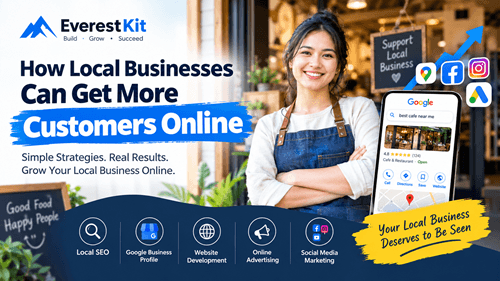
Running a local business is no longer just about having a good product, offering quality service, or having a convenient location. Today, potential customers often search online before deciding where to buy, whom to contact, or which business to visit.
Whether you run a restaurant, clothing store, salon, consultancy, repair service, hotel, agency, retail shop, or professional service, your online presence can make it easier for people to discover your business and learn what you offer.
The challenge is knowing where to start.
You don't necessarily need a huge advertising budget or a complicated marketing strategy. A strong online presence starts with accurate business information, useful content, a professional profile, good customer experiences, and a simple way for interested people to contact you.
In this guide, we'll explain practical ways local businesses can attract more customers online and how a digital service provider such as EverestKit can help with business profiles, online advertising, website presence, and digital marketing.
What Does It Mean to Get Customers Online?
Getting customers online means using digital channels to help potential customers:
- Discover your business
- Learn about your products or services
- Understand why your business may be suitable for them
- Contact or visit your business
- Become a customer
- Return or recommend your business
The journey might look like this:
Google Search → Business Profile → Website → Trust → Contact → Customer
Or:
Facebook/Instagram → Content → Website → Inquiry → Customer
The goal isn't simply to get more website visitors or social media followers. The goal is to create a useful path from discovery to action.
1. Make Your Business Easy to Find Online
One of the first questions a potential customer may ask is:
"Can I find this business online?"
If your business doesn't appear when people search for your name, service, product, or location, you may be missing opportunities.
Start by creating a consistent online presence.
Depending on your business, this can include:
- A professional website
- Google Business Profile
- Facebook business page
- Instagram business profile
- TikTok profile
- LinkedIn company page
- Relevant local business directories
- Industry-specific platforms
You don't have to create accounts on every platform.
Choose the platforms that your potential customers actually use and keep your information accurate.
2. Create a Google Business Profile
For eligible local businesses, Google Business Profile can be an important part of an online presence.
Google says a verified Business Profile can help eligible businesses manage how they appear on Google Search and Maps. Businesses can provide information such as their hours, website, phone number, location or service area, photos, and customer reviews.
A useful profile should contain accurate information such as:
- Real business name
- Correct category
- Business address or service area
- Opening hours
- Website
- Contact information
- Quality business photos
- Products or services
- Relevant business description
Google's guidelines also say that the business name should accurately represent the real-world business name and that businesses should provide accurate address or service-area information.
Why does this matter?
Imagine someone searches:
"restaurant near me"
or:
"web development company in Kathmandu"
A complete and accurate online profile gives potential customers useful information when they're researching their options.
However, don't treat your profile as a place to stuff keywords.
Your information should describe the actual business.
3. Build a Professional Business Profile
Your business profile is often one of the first impressions a potential customer gets.
A weak profile might have:
- No logo
- Poor-quality images
- Incomplete information
- No description
- Incorrect opening hours
- No website
- No service information
A professional profile should communicate:
Who are you?
What do you offer?
Where do you operate?
How can customers contact you?
Why should someone learn more about your business?
Google's Business Profile guidance recommends providing useful business information, photos and videos, and keeping important details updated.
This is an area where professional digital services can save business owners time.
4. Create a Business Website
Social media can help people discover your business, but a website gives you a place where you can explain your business in more detail.
A basic business website can include:
Home Page
Introduce your business and explain what you provide.
About Page
Tell visitors about the business, team, experience, or mission.
Services Page
Explain your services clearly.
Products Page
Show important products and their relevant details.
Portfolio
Display examples of your work.
Testimonials
Share genuine customer experiences where appropriate.
Contact Page
Give visitors an easy way to get in touch.
Your website doesn't need to be complicated.
It needs to be useful, clear, trustworthy, mobile-friendly, and easy to navigate.
5. Optimize Your Website for Local Search
Local SEO helps search engines understand the relationship between your business, services, and the locations you serve.
For example, instead of creating a page that only says:
"We provide web development."
you could clearly explain:
"We provide website development services for small businesses and organizations in Kathmandu and other service areas we support."
The wording should reflect what your business actually does.
Important areas to consider include:
- Page titles
- Headings
- Service descriptions
- Location information
- Business contact details
- Internal links
- Helpful articles
- Relevant images
- Mobile usability
- Page speed
Don't write content simply to insert keywords repeatedly.
Write for the customer first.
6. Create Separate Pages for Important Services
If your company offers multiple services, consider giving important services their own pages.
For example, a digital agency might have:
- SEO Services
- Website Development
- Social Media Marketing
- Digital Advertising
- Content Creation
- Branding
- Graphic Design
A dedicated service page allows you to explain the service properly.
It can answer questions such as:
What is the service?
Who is it for?
What does the customer receive?
How does the process work?
How can someone request the service?
This is much more useful than putting every service into one large paragraph.
7. Use Social Media to Demonstrate Your Business
Social media can help potential customers understand your business before they contact you.
Instead of only posting advertisements, share useful content.
For example:
Educational Posts
"5 things to check before hiring a website developer."
Product Demonstrations
Show how your product works.
Before-and-After Content
Show legitimate examples of your work.
Customer Questions
Answer common questions publicly.
Behind-the-Scenes Content
Show how your team creates products or delivers services.
Business Updates
Share new services, events, projects, or announcements.
The objective is to provide useful information while making your business easier to remember.
8. Use High-Quality Photos and Videos
Visual content can make a business profile and social media presence much more informative.
Depending on your business, consider showing:
- Storefront
- Office
- Products
- Team
- Services
- Projects
- Packaging
- Work process
- Completed work
Avoid using misleading images that don't represent your actual business.
Real and relevant images can help potential customers understand what to expect.
9. Collect Genuine Customer Reviews
Reviews can provide potential customers with additional information about other people's experiences.
After providing a good service, you can politely ask customers to leave an honest review.
You can also respond professionally to reviews.
Google provides tools for businesses to read and respond to customer reviews and share review-request links or QR codes.
Don't buy fake reviews or create misleading testimonials.
The purpose of reviews should be to represent genuine customer experiences.
10. Keep Your Business Information Updated
Imagine a customer searches for your business and finds:
Old phone number
Wrong opening hours
Outdated address
Old website
Incorrect service information
That can create unnecessary friction.
Review your online profiles regularly.
Check:
- Business name
- Address
- Service area
- Phone
- Website
- Opening hours
- Services
- Photos
- Social media links
Google allows verified businesses to update information such as address, hours, contact information, photos, and other profile details.
11. Publish Useful Local Content
A business blog can attract people who are searching for information before they're ready to purchase.
For example, a local restaurant might publish:
"How to Choose a Restaurant for a Family Celebration"
A web development company could publish:
"How Much Does a Business Website Need to Cost?"
A travel company could publish:
"How to Plan a Weekend Trip"
A clothing business could publish:
"How to Choose the Right Outfit for Different Occasions"
The important point is that the article should genuinely answer the reader's question.
Useful content can introduce your business to people earlier in their buying journey.
12. Create Helpful Offers
Once someone discovers your business, give them a clear reason to take the next step.
Depending on your business, this could be:
- Free consultation
- Free initial discussion
- Free estimate
- First-order offer
- Free website audit
- Free sample
- Downloadable guide
- Consultation booking
- Service package
The offer should be genuine and clearly explained.
Avoid creating fake urgency or misleading promotions.
13. Make Contacting Your Business Easy
A customer shouldn't have to search through your website for ten minutes to find out how to contact you.
Consider providing:
- Contact form
- Phone number
- Messaging option
- Booking form
- Store address
- Service area
Use clear calls to action such as:
Request a Quote
Book a Consultation
Contact Us
Get Started
Ask About Our Services
The appropriate option depends on what your business actually sells.
14. Use Online Advertising Strategically
Organic marketing can take time.
Advertising can help businesses put their offers in front of selected audiences.
Potential advertising channels include:
- Google Ads
- Facebook Ads
- Instagram Ads
- YouTube Ads
- TikTok Ads
Google explains that businesses can use Google Ads to promote their business across Google properties, including Search, Display, YouTube, and eligible Maps-related experiences.
But advertising alone doesn't guarantee customers.
Your advertisement, landing page, offer, targeting, budget, and follow-up process all affect the result.
A simple advertising funnel could be:
Advertisement
↓
Landing Page
↓
Offer
↓
Inquiry
↓
Follow-up
↓
Customer
15. Don't Send Every Advertisement to Your Homepage
This is a common mistake.
Suppose you're advertising:
"Professional Website Development for Small Businesses."
Sending users to a homepage containing ten unrelated services may create unnecessary confusion.
Instead, consider sending them to a relevant service page explaining:
- The problem
- Your service
- What is included
- Examples
- Process
- Frequently asked questions
- Call to action
A focused landing page can make the customer's next step clearer.
16. Track Your Marketing Results
Don't judge your online marketing only by likes and followers.
Track business outcomes.
Useful metrics include:
- Website visitors
- Search impressions
- Search clicks
- Contact form submissions
- Phone inquiries
- Booking requests
- Social media engagement
- Advertising clicks
- Leads
- Customers
- Revenue
For example:
1,000 visitors → 50 inquiries → 10 customers
can tell you much more about your marketing than simply saying:
"Our post received 10,000 views."
The right metrics depend on your business model.
17. Create a Simple Online Customer Journey
A local business can organize its marketing around a simple customer journey.
Step 1: Discovery
People find your business through Google, social media, advertising, referrals, or content.
Step 2: Research
They look at your website, profile, reviews, photos, and services.
Step 3: Trust
They evaluate whether your business appears legitimate and suitable for their needs.
Step 4: Action
They call, message, visit, book, or request a quote.
Step 5: Experience
You deliver the promised product or service.
Step 6: Relationship
Satisfied customers may return, leave genuine reviews, or recommend your business.
This approach helps connect marketing activity with actual business goals.
How EverestKit Can Help Your Business Get Online
Many business owners understand that they need an online presence but don't have the time or technical knowledge to create everything themselves.
EverestKit can help businesses build and improve their digital presence through services such as business profile creation, website development, digital marketing, content creation, branding, and online advertising support.
For example, EverestKit can help with:
Business Profile Setup
Help organize the information needed for your online business presence, including business descriptions, services, contact details, images, and other profile content.
For eligible local businesses, Google Business Profile can be managed on Search and Maps at no charge, subject to Google's eligibility and verification requirements.
Social Media Profile Creation
Businesses can establish professional profiles and prepare consistent:
- Profile information
- Business descriptions
- Profile images
- Cover graphics
- Service information
- Contact details
- Content ideas
Website Creation
EverestKit can help businesses create a website that explains their services and provides customers with a clear way to contact them.
Advertising Support
EverestKit can help prepare advertising materials and campaigns for platforms such as:
- YouTube
- Other suitable digital channels
Advertising should be based on the business's target audience, objectives, budget, and available data.
Content Creation
Regular useful content can help businesses communicate with potential customers.
EverestKit can help create:
- Blog articles
- Social media posts
- Promotional graphics
- Short-form video/ video-scripts
- Business descriptions
- Website content
Digital Marketing Strategy
Instead of treating every platform separately, EverestKit can help connect your website, business profiles, social media, content, and advertising into a more organized digital marketing system.
Why Your Business Should Start With the Basics
You don't need to launch a massive digital marketing campaign on day one.
Start with the fundamentals:
1. Create your business profile
2. Make your information accurate
3. Build a professional website
4. Add your services
5. Publish useful content
6. Build genuine customer reviews
7. Create social media profiles
8. Test appropriate advertising
9. Track inquiries and customers
10. Improve based on real results
This approach makes it easier to identify what is helping your business and what needs improvement.
Need help creating your business profile, website, content, or online advertising presence? Explore EverestKit's digital services and get your business online.
Local Business Online Marketing Checklist
Use this checklist to evaluate your current online presence:
- Professional website
- Mobile-friendly website
- Google Business Profile, if eligible
- Accurate business information
- Correct business category
- Service descriptions
- High-quality business photos
- Genuine customer reviews
- Social media profiles
- Useful social media content
- Helpful blog content
- Clear contact options
- Clear calls to action
- Analytics and conversion tracking
- Advertising strategy
- Regular profile updates
- Customer follow-up process
Frequently Asked Questions
How can a small business get customers online?
Start by creating a professional online presence, setting up appropriate business profiles, building a useful website, publishing helpful content, collecting genuine reviews, using social media, and testing targeted advertising.
Is Google Business Profile free?
Google states that eligible businesses can add or claim a Business Profile at no charge. Eligibility and verification requirements may apply.
Does every business qualify for Google Business Profile?
No. Google says Business Profiles are intended for businesses that make in-person contact with customers, such as businesses with a physical location or service-area businesses. Online-only businesses generally aren't eligible for a Business Profile.
How much should a small business spend on advertising?
There isn't one budget that works for every business. Your budget should depend on your goals, customer value, competition, location, advertising channel, and ability to convert leads into customers.
Start with a measurable test for example $1-$3 per day for 30 days at one platform rather than assuming that a large budget automatically produces better results.
Does having a website guarantee more customers?
No. A website is one part of a broader marketing system. Results depend on factors such as visibility, relevance, website quality, offer, customer demand, competition, and conversion process.
How often should a business post on social media?
There is no universal posting frequency that guarantees results. Focus on useful, relevant content that you can maintain consistently rather than publishing low-quality posts simply to increase volume.
Final Thoughts
Getting more customers online isn't about finding one magic marketing technique.
It is about making your business easier to find, understand, trust, and contact.
Start with accurate business information. Build a professional profile. Create a useful website. Publish content that answers real customer questions. Collect genuine reviews. Use social media to demonstrate what you offer. Then test advertising and measure the results.
For businesses that don't have the time or expertise to manage all of these activities themselves, EverestKit can help with business profile creation, website development, content creation, digital marketing, and advertising support.
The most important thing is to build an online presence that accurately represents your real business and gives potential customers useful information when they're ready to make a decision.
Need help creating your business profile, website, content, or online advertising presence? Explore EverestKit's digital services and get your business online.
Community Discussion
Join the conversation and share your perspective with other readers
Community Comments
No Comments Yet
Start the conversation! Be the first to share your thoughts on this article.