SEO Checklist for Beginners (Step-by-Step Guide to Rank Higher in 2026)
Looking for a complete SEO checklist for beginners? Follow this step-by-step SEO guide covering keyword research, on-page SEO, technical SEO, and backlinks to rank higher on Google in 2026.
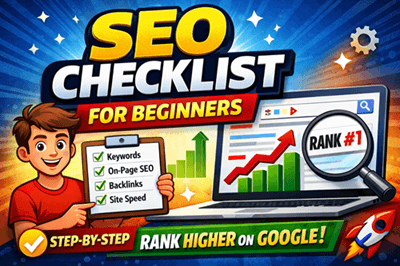
If you’ve just started a blog or website and want to rank on Google, you’ve probably heard about SEO. But where do you start?
Search Engine Optimization (SEO) can feel overwhelming in the beginning. The good news? You don’t need advanced skills to get started. You just need a clear checklist.
This beginner-friendly SEO checklist will guide you step-by-step so you can build a strong foundation and improve your chances of ranking higher in search results.
✅ 1. Keyword Research (The Foundation of SEO)
Before writing any content, you must know what people are searching for.
✔ Find the Right Keywords
- Use tools like Google Keyword Planner, Ubersuggest, or Google autocomplete.
- Look for low-competition keywords.
- Focus on long-tail keywords (3–5 word phrases).
Example:
Instead of targeting “SEO,” target “SEO checklist for beginners.”
✔ Understand Search Intent
Ask yourself:
- Is the user looking for information?
- Do they want to buy something?
- Are they comparing options?
Matching search intent increases your ranking chances.
✅ 2. Create High-Quality Content
Google prioritizes helpful and user-focused content.
✔ Write for Humans First
- Use simple language.
- Break content into short paragraphs.
- Use bullet points and headings.
✔ Provide Real Value
Your article should:
- Answer the main question clearly.
- Provide actionable steps.
- Solve a real problem.
✔ Use Proper Formatting
- H1 for title
- H2 for main headings
- H3 for subheadings
Good formatting improves readability and SEO.
✅ 3. On-Page SEO Checklist
On-page SEO can help search engines understand what your content is about.
✔ Optimize Title Tag
- Include your main keyword.
- Keep it under 60 characters.
- Make it compelling.
✔ Write a Strong Meta Description
- Include the target keyword.
- Keep it under 160 characters.
- Make users want to click.
✔ Use Keywords Naturally
- Include keyword in:
- First 100 words
- At least one H2
- URL
- Image alt text
Avoid keyword stuffing.
✔ Optimize Images
- Compress images.
- Use descriptive file names.
- Add alt text with relevant keywords.
✅ 4. Technical SEO Basics
Even well written content won’t rank if your website has technical issues and errrors.
✔ Improve Website Speed
- Use fast hosting.
- Compress images.
- Enable caching.
✔ Make Your Site Mobile-Friendly
Most users browse on mobile.
Ensure your website works smoothly on all devices.
✔ Use HTTPS
Secure websites (with SSL certificate) rank better and build trust.
✔ Create and Submit Sitemap
Submit your sitemap to Google Search Console to help Google index your site faster.
✅ 5. Internal Linking Strategy
Internal links help:
- Users navigate your website
- Search engines understand content structure
- Increase time on site
Link to relevant blog posts within your article using descriptive anchor text for better rank.
✅ 6. Build Backlinks (Off-Page SEO)
Backlinks are links from other websites to yours. They act as votes of trust.
Beginner-Friendly Ways to Get Backlinks:
- Guest posting
- Writing high-quality shareable content
- Directory submissions
- Sharing on social media
Focus on quality, not quantity.
✅ 7. Use Google Search Console & Analytics
Track your progress using:
- Google Search Console (monitor keywords and indexing)
- Google Analytics (track traffic and behavior)
These tools help you improve based on real data.
✅ 8. Focus on User Experience (UX)
Google rewards websites that users love.
Improve:
- Page loading speed
- Clear navigation
- Clean design
- Easy-to-read fonts
If visitors stay longer, your rankings improve.
✅ 9. Update Content Regularly
SEO is not one-time work.
- Update old blog posts.
- Add new statistics.
- Improve outdated information.
- Optimize underperforming pages.
Fresh content signals relevance.
🎯 Quick SEO Checklist Summary
Here’s your simplified SEO checklist for beginners:
✔ Do proper keyword research
✔ Create helpful, original content
✔ Optimize title, meta description & headings
✔ Improve site speed and mobile responsiveness
✔ Add internal links
✔ Build quality backlinks
✔ Track performance
✔ Update content regularly
🚀 Final Thoughts
SEO may seem complex at first, but once you follow a structured checklist, it becomes manageable.
Start with keyword research. Focus on helpful content. Improve technical basics. Then build authority gradually.
Remember — SEO is a long-term strategy. Consistency beats shortcuts.
If you apply this beginner SEO checklist correctly, you’ll build a strong foundation that can help your website rank higher in 2026 and beyond.
Community Discussion
Join the conversation and share your perspective with other readers
Community Comments
No Comments Yet
Start the conversation! Be the first to share your thoughts on this article.