YouTube Monetization Terms Update 2026: New YPP Rules Explained
Learn about YouTube's latest monetization terms for 2026 and the upcoming 2027 YPP changes, including new eligibility thresholds, Shorts revenue rules, Premium Lite, and content policies.
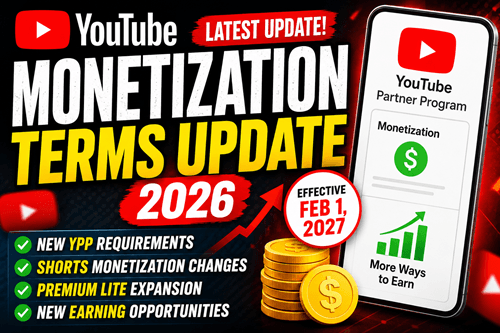
YouTube has announced major upcoming changes to its YouTube Partner Program (YPP), making 2026 an important year for creators who earn money from videos, Shorts, memberships, and other monetization features.
The changes were announced by YouTube on August 10, 2026, and the new terms are scheduled to take effect on February 1, 2027. YouTube says the changes are designed to better reward active creators, adapt monetization to changing viewing habits, and introduce additional ways for creators to earn.
The biggest changes involve:
- New YPP entry requirements for advertising and YouTube Premium revenue
- Changes to Shorts monetization
- Expansion of Premium Lite
- New creator incentive opportunities
- Updated requirements for maintaining an active YPP channel
- Updated monetization agreements that creators will need to accept
If you currently make money on YouTube—or plan to monetize your channel in the future—understanding these changes can help you prepare before the new terms take effect.
What Are the Latest YouTube Monetization Changes?
The upcoming YouTube Partner Program update has three major areas of change:
- Premium Lite is expanding
- Shorts monetization is changing
- YPP advertising and Premium entry thresholds are increasing for new creators
YouTube says these changes are part of a broader effort to support creators while adapting the Partner Program to the way audiences consume content today.
Importantly, the new advertising and Premium entry thresholds will not affect creators who are already in the YouTube Partner Program.
1. YouTube Is Raising the YPP Entry Requirements for New Creators
One of the biggest changes is the new threshold for creators who want to join YPP and earn from advertising and YouTube Premium revenue.
Starting February 1, 2027, new creators will need:
Option 1: Long-form videos
- 1,000 subscribers
- 8,000 qualified public watch hours during the previous 365 days
Option 2: YouTube Shorts
- 1,000 subscribers
- 20 million qualified Shorts views during the previous 90 days
These thresholds apply to new creators seeking advertising and Premium revenue sharing. Existing YPP creators will not be removed from the program simply because they do not meet the new entry thresholds.
This is a significant change from the current full YPP entry requirements of 1,000 subscribers plus either 4,000 qualified watch hours or 10 million qualified Shorts views under the existing rules.
What does this mean for new YouTubers?
Growing a channel to monetization may require more consistent content, stronger audience retention, and a clearer content strategy.
Simply reaching 1,000 subscribers will not be enough for new creators to qualify for advertising and Premium revenue under the upcoming rules.
2. Existing YouTube Partners Are Not Losing YPP Status Because of the New Thresholds
This point is especially important because many creators may misunderstand the announcement.
If you are already accepted into YPP, YouTube says the new 8,000-hour and 20-million-Shorts-view entry thresholds will not affect your existing YPP status.
In other words, the higher thresholds are primarily about new creators entering the program, not automatically removing established YPP members.
However, YouTube is also introducing updated activity requirements for channels already in YPP.
3. YouTube Is Introducing New Channel Activity Requirements
Starting February 1, 2027, YouTube will use additional activity requirements to determine whether a channel remains active in YPP.
A channel can qualify as active by meeting at least one of these requirements:
- 1,000 qualified watch hours during the previous 365 days
- 1 million qualified Shorts views during the previous 90 days
- At least 2 long-form videos uploaded during a 90-day period
- At least 5 Shorts uploaded during a 90-day period
This change is particularly relevant for creators who have stopped uploading for long periods.
YouTube says most creators in YPP already meet these activity expectations, but channels that fall below the requirements will receive an extended 90-day opportunity to restore active status.
What should creators do?
You do not necessarily need to upload every day.
Instead, focus on maintaining a realistic publishing schedule.
For example:
Long-form strategy:
- 1 quality video every 1–2 weeks
Shorts strategy:
- 2–5 useful Shorts per week
Consistency is more sustainable than uploading large amounts of low-quality content simply to remain active.
4. YouTube Shorts Monetization Is Changing
YouTube is also changing how Shorts advertising and subscription revenue sharing works.
Beginning February 1, 2027, creators will need to maintain:
10 million qualified Shorts views during the previous 90 days
to continue earning from the Shorts Creator Pool.
However, falling below this threshold does not mean the creator is removed from YPP.
YouTube says channels below the 10-million-view threshold can remain in YPP and continue earning from eligible long-form content. Shorts revenue sharing can resume when the channel reaches the required Shorts-view threshold again.
Why is YouTube changing Shorts monetization?
YouTube says it wants to reward creators who generate consistent viewership, conversation, and engagement.
This means Shorts creators may need to think beyond simply producing large quantities of short videos.
A stronger strategy is to create Shorts that:
- Hold attention quickly
- Encourage viewers to watch more content
- Generate meaningful engagement
- Have a recognizable creator style
- Connect with a specific audience
- Lead viewers toward longer videos or other products
5. New Shorts Incentive Opportunities Are Coming
The Shorts update is not only about higher requirements.
YouTube also says it is introducing additional incentive programs that may provide creators with opportunities related to:
- YouTube Shopping
- Brand-deal production credits
- Cultural trend activations
- Other performance-based opportunities
YouTube says more information about these programs will be provided as they launch.
This suggests that Shorts monetization may increasingly involve several revenue opportunities rather than relying exclusively on traditional advertising revenue.
6. Premium Lite Is Expanding
Another major change is the expansion of YouTube Premium Lite.
YouTube says Premium Lite will expand to all countries where YouTube Premium is available.
Premium Lite is designed to provide viewers with fewer interruptions while watching most YouTube and YouTube Kids content, along with features such as offline and background viewing where applicable.
YouTube says creators will share in revenue generated through Premium subscriptions.
For Premium Lite, YouTube says the creator revenue pool represents 60% of net subscription revenue, while the standard Premium pool represents 30% of net subscription revenue. The allocation is then distributed according to creator watch time and views, with the applicable creator revenue share applied afterward.
This could become an increasingly relevant source of income for creators as Premium Lite expands.
7. YouTube Is Still Focusing Heavily on Original and Authentic Content
The latest YPP changes should not be viewed separately from YouTube's existing monetization policies.
YouTube continues to emphasize that monetized content should be original and authentic.
In July 2025, YouTube renamed its previous “repetitious content” policy to “inauthentic content” to clarify that repetitive or mass-produced content can be ineligible for monetization. YouTube stated that this was a clarification of its existing policy rather than a completely new monetization rule.
This is especially important for creators using AI, automation, templates, stock footage, or large-scale content production.
8. Does YouTube Allow AI-Generated Content?
Yes, using AI does not automatically make a video ineligible for monetization.
The important question is whether the finished content provides original value and authentic creative input.
YouTube's current monetization policy specifically gives examples indicating that creative tools, including AI, can be used when they help create a unique, well-researched, or creative narrative.
The problem is not simply the use of AI.
The bigger concern is low-value, repetitive, mass-produced content.
For example, a channel that automatically generates hundreds of nearly identical videos with minimal variation or original insight may have difficulty meeting YouTube's monetization standards.
By contrast, a creator can use AI as a production assistant while still contributing:
- Original research
- Personal experience
- Commentary
- Analysis
- Storytelling
- Editing decisions
- Original visuals
- Unique opinions
- Educational explanations
The goal should be to use AI as a tool rather than allowing automation to replace the creator's contribution.
9. Reused Content Is Still a Major Monetization Risk
Another important point is that YouTube's reused content policy has not been eliminated or replaced.
YouTube states that reused content includes material taken from YouTube or other online sources without significant original commentary, substantive modification, or educational or entertainment value.
Examples that can create monetization problems include:
- Compilations with little commentary
- Re-uploaded social media videos
- Movie or TV clips with minimal changes
- Content copied from other websites
- Collections of songs
- Videos that simply reproduce material created by others
- Reading articles or news feeds without meaningful original contribution
However, transformed content can be monetizable when the creator adds substantial value.
Examples include:
- Critical reviews
- Commentary videos
- Reaction videos with meaningful commentary
- Educational analysis
- Sports analysis
- Edited clips with a new storyline
- Videos where the creator explains or demonstrates their contribution
YouTube also emphasizes that reused-content monetization rules are separate from copyright enforcement. Having permission to use someone else's material does not automatically guarantee YPP eligibility.
10. What About Faceless YouTube Channels?
Faceless channels are not automatically prohibited from monetization.
The key issue is not whether your face appears on camera.
A faceless channel can still provide substantial original value through:
- Original narration
- Research
- Educational explanations
- Original storytelling
- Screen recordings
- Animation
- Original graphics
- Commentary
- Analysis
- Demonstrations
The risk increases when a channel relies on automated production, repetitive templates, copied material, or minimal human input.
Therefore, a better approach to building a faceless YouTube channel is:
Research → Original Script → Original Narration → Meaningful Editing → Unique Visuals → Useful Information
rather than:
AI Script → AI Voice → Stock Clips → Automatic Upload → Repeat
The second approach can create the appearance of mass-produced content, which is exactly the type of content YouTube's inauthentic-content policy is designed to address.
11. YouTube Monetization Is More Than Just Reaching the Numbers
Many creators think monetization is simply a numbers game.
It isn't.
Meeting subscriber and watch-time requirements does not guarantee approval.
YouTube reviews channels for compliance with its monetization policies, Community Guidelines, copyright requirements, advertiser-friendly standards, and other applicable policies.
YouTube reviewers may consider areas such as:
- Your channel's main theme
- Most-viewed videos
- Newest videos
- Videos generating the largest share of watch time
- Titles
- Thumbnails
- Descriptions
- About section
- Overall content quality and originality
This means creators should think about the whole channel, not just individual videos.
12. What Are the New YouTube Terms Creators Need to Accept?
YouTube says creators will need to review updated monetization terms in YouTube Studio.
The relevant modules include:
- Watch Page Monetization Module
- Shorts Monetization Module
- Commerce Product Module, where applicable
The deadline to accept the updated terms is January 31, 2027.
The new terms take effect on February 1, 2027.
If a creator does not accept the relevant terms by the deadline, YouTube says the creator will stop earning from the associated monetization features beginning February 1, 2027.
The creator does not automatically lose YPP status, and accepting the terms later can restore access to the affected monetization features.
13. What Creators Should Do Before the New Rules Take Effect
Creators do not need to panic.
Instead, use the time before February 2027 to strengthen your channel.
Step 1: Review Your Existing Videos
Look through your older content and identify videos that are:
- Repetitive
- Heavily dependent on reused material
- Very low-value
- Automatically generated
- Nearly identical to other videos
- Potentially problematic under advertiser-friendly guidelines
Improving your overall channel quality is more useful than simply chasing another upload target.
Step 2: Build a Strong Content Identity
Your channel should have a clear reason for existing.
Ask yourself:
Why should someone watch my videos instead of thousands of similar videos?
Your answer could be:
- Better research
- Better storytelling
- Practical tutorials
- Personal experience
- Industry knowledge
- Entertainment
- Unique analysis
- Original experiments
A recognizable content identity can make your channel more valuable to both viewers and advertisers.
Step 3: Use AI Carefully
AI can help with:
- Brainstorming
- Research organization
- Script outlines
- Editing
- Captions
- Thumbnail ideas
- Translation
- Production workflows
But don't allow AI automation to turn your channel into a collection of nearly identical videos.
Add your own judgment, research, examples, experiences, and creative decisions.
Step 4: Focus on Viewer Value
YouTube's monetization policies emphasize content that provides viewers with something useful, educational, creative, or entertaining.
Before publishing a video, ask:
What does the viewer gain from watching this?
If the answer is unclear, the video probably needs improvement.
Step 5: Don't Chase Views at Any Cost
High views can be useful, but misleading thumbnails, repetitive videos, spam-like uploads, or manipulative content can create long-term problems.
A better strategy is to build:
Audience → Trust → Watch Time → Returning Viewers → Revenue
rather than:
Click → View → Forget
YouTube Monetization Requirements: Old vs New
| Requirement | Current full YPP entry | From Feb. 1, 2027 |
| Subscribers | 1,000 | 1,000 |
| Long-form qualified watch hours | 4,000 / 12 months | 8,000 / 365 days |
| Qualified Shorts views | 10 million / 90 days | 20 million / 90 days |
| Existing YPP creators affected by new entry thresholds? | — | No |
| Fan funding/shopping entry thresholds | Existing rules | No change announced |
The new 2027 thresholds apply to new creators seeking advertising and Premium revenue sharing, while existing YPP creators are not impacted by the new entry thresholds.
What This Means for Small YouTube Channels
For small channels, the biggest lesson is simple:
Quality and consistency matter more than mass production.
The higher future entry thresholds could make it harder for new creators to reach advertising and Premium revenue sharing.
That makes channel strategy more important.
Instead of uploading random videos across different topics, consider building around one clear audience.
For example:
Technology Channel
→ Smartphone tutorials
→ App reviews
→ AI tools
→ Software guides
→ Technology news
Or:
Digital Marketing Channel
→ SEO tutorials
→ Facebook marketing
→ Google Ads
→ Website optimization
→ Social media strategies
A focused channel can make it easier to build returning viewers and develop expertise.
Is YouTube Still Worth It in 2026?
Yes—but creators need to approach YouTube as a long-term business rather than a quick monetization shortcut.
YouTube says the Partner Program now has more than 3 million creators, and the company expects to pay creators more in 2027 than in 2026.
At the same time, the platform is making it increasingly important for creators to produce content that has genuine value.
That means the strongest opportunities may belong to creators who combine:
Original Content + Strong Audience Understanding + Consistency + Multiple Revenue Streams
Instead of relying entirely on advertising, creators can explore:
- YouTube ads
- Shorts revenue
- YouTube Premium revenue
- Channel memberships
- Super Chat
- Super Thanks
- YouTube Shopping
- Brand partnerships
- Affiliate marketing
- Digital products
- Services
- Courses
- Sponsorships
The more useful your audience is to your business, the less dependent you become on a single monetization source.
Frequently Asked Questions
Will YouTube remove existing monetized channels because of the new 8,000-hour requirement?
No. YouTube says the new 8,000-hour and 20-million-Shorts-view thresholds apply to new creators entering YPP for advertising and Premium revenue sharing. Existing YPP creators are not affected by these new entry thresholds.
Will AI-generated videos be banned from YouTube monetization?
No. AI use itself is not automatically disqualifying. YouTube's policies focus on originality, authenticity, meaningful value, and whether content is repetitive or mass-produced.
Can faceless YouTube channels still be monetized?
Yes. Being faceless is not itself a monetization violation. The content still needs to provide meaningful original value and comply with YouTube's monetization policies.
What happens if I fall below 10 million Shorts views?
Starting February 1, 2027, creators need 10 million qualified Shorts views over 90 days to earn from Shorts ads and subscription revenue sharing. Falling below the threshold does not remove the channel from YPP or affect eligible long-form earnings. Shorts revenue sharing can resume when the threshold is reached again.
When do the new YouTube monetization terms take effect?
The new terms are scheduled to take effect on February 1, 2027. Creators need to review and accept the applicable updated terms by January 31, 2027 to continue earning from the associated monetization features.
Are YouTube monetization requirements getting harder?
For new creators seeking advertising and Premium revenue sharing, the upcoming thresholds are higher. However, YouTube is also introducing additional earning opportunities, including expanded Premium Lite and new Shorts-related incentive programs.
Final Thoughts
YouTube's latest monetization update is less about simply changing a few numbers and more about changing the direction of the creator economy.
Starting in 2027, new creators will face higher thresholds for advertising and Premium revenue sharing, while Shorts creators will need to maintain stronger performance to participate in Shorts revenue sharing.
At the same time, YouTube is expanding Premium Lite and introducing new earning opportunities for creators.
The most important lesson for creators is to avoid building a channel around mass-produced, repetitive, or low-value content.
Instead, create videos that are genuinely useful, entertaining, educational, or original.
If you use AI, automation, stock footage, or other production tools, use them to improve your creative process—not to replace originality.
The creators most likely to build sustainable YouTube businesses are those who understand that monetization begins with viewer value, not simply subscriber numbers.
Content that helps people, keeps them watching, and gives them a reason to come back will always have a stronger foundation than content created only to chase the algorithm.
Sources and Official References
- YouTube — Changes to the YouTube Partner Program
- YouTube Official Blog — New opportunities to earn and changes to the YouTube Partner Program
- YouTube Help — Channel monetization policies
- YouTube Help — YPP overview and eligibility
Last Updated: August 21, 2026
Community Discussion
Join the conversation and share your perspective with other readers
Community Comments
No Comments Yet
Start the conversation! Be the first to share your thoughts on this article.